
The best embedded finance experiences are instant: a merchant sees a personalised financing offer, accepts, and receives funding straight away.
YouLend’s pre-approval journey has matured over several years in the market, and our model offers high performance and broad eligibility across the merchant base. But through our experience working with a broad range of merchants and platforms, we know that having all the necessary information before a merchant applies is not always possible. Many businesses are complex, taking repayments through marketplaces, ecommerce platforms, POS systems, invoices, bank transfers and multiple payment providers at the same time.
An instant pre-approved offer depends on having enough data to understand the merchant before they apply. When a platform sees only part of a business’s revenue, pre-qualification can widen eligibility by inviting the merchant to complete the picture. This is why YouLend offers both.
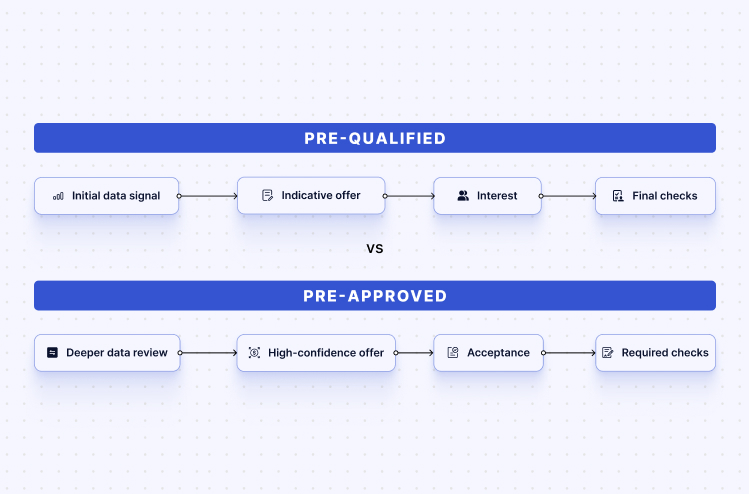
Pre-Approved offers are firm offers generated from the platform data available at the time. Eligible merchants can review the offer, sign their contract and proceed to funding in a few clicks.
Pre-qualified offers are invitations to apply. Using the data available, YouLend estimates what a merchant may be eligible for and uses that estimate to present financing offers. The merchant then provides additional information, allowing YouLend to assess the business and make the best available offer.
So how do we decide who to pre-approve, and who to pre-qualify?
The right journey depends on what the merchant needs and what the available data can support. Some merchants benefit most from speed and simplicity, while for others, assessing total revenue and business health can produce a more appropriate offer.
For many of our programmes, the answer is segmentation: using different financing journeys for different merchant cohorts based on revenue visibility, business maturity and underwriting confidence.
The decision at a glance
Where pre-qualified offers work best
Early signals allow YouLend to estimate whether a merchant is likely to be eligible and how much financing they may be able to access. This tried-and-tested method enables marketing to merchants before they begin an application.
Example marketing hook: "Based on your business performance, you may qualify for up to GBP 25,000 in financing."
The idea is simple: surface a capital opportunity before the merchant starts looking elsewhere, without pretending the platform has more underwriting certainty than it does.
Pre-qualified models are strongest in ecosystems where merchants are complex, and generate revenue across multiple channels. A restaurant, for example, may take revenue through delivery apps, direct online orders, in-store card payments, reservations, invoices and bank transfers. A platform may see one part of that before the merchant applies, but not the whole business.
In that environment, waiting for perfect visibility can reduce reach. Pre-qualified offers allow financing providers to engage more merchants earlier, then deepen underwriting once the merchant expresses interest.
The Tradeoff
Pre-qualified offers broaden reach, but they are not guaranteed offers. Final underwriting is still required and offer amounts may change. Some merchants may not qualify once deeper checks are completed. This is often the right model when the cost of excluding good merchants is higher than the cost of adding another underwriting step.
Where pre-approved models work best
A pre-approved offer is firm, and can be accepted on the spot. We have reviewed a rich set of merchant data and have strong confidence in the funding we are offering to the merchant, and this is reflected in our marketing.
Example Marketing Hook: "You are pre-approved for GBP 50,000."
The goal is a faster journey with minimal delay between offer review, acceptance and funding. This works best when the platform has a clear understanding of the merchant, a rich history of revenue, and consistent merchant performance.
Pre-approved models are most effective in highly integrated ecosystems where the platform has deep visibility into merchant performance: most payment data sits within one platform, transactions are consistent, the platform owns or controls the transaction flow, and merchant behaviour is relatively predictable.
In these conditions, pre-approval can increase conversion because the offers are specific, timely and credible. The merchant does not have to interpret a possibility, they see a concrete funding option.
The Tradeoff
Pre-approval is only possible where platform data is sufficiently complete and consistent to support a firm offer. Where material revenue sits elsewhere, relying solely on the data at hand may understate the merchant’s position.
How to segment the financing Journey
Mature embedded lending programmes increasingly use both models. They segment merchants by the data available, the confidence that data can support, and the commercial value of reaching the cohort.
A practical segmentation might look like this:
Segmentation affects the route to market, the data required, the messaging shown to merchants, the role of the lending provide and the implementation route. A platform may use pre-qualification for broad discovery, then offer a faster pre-approved journey to cohorts where the data supports greater certainty.
Which model is best?
The question is where platform data supports an immediate, high-confidence offer, versus where asking the merchant for more information can unlock a better outcome. The strongest programmes use both journeys, matched to the needs and data profile of each merchant cohort.








.jpg)