
A credit score cannot carry the whole decision
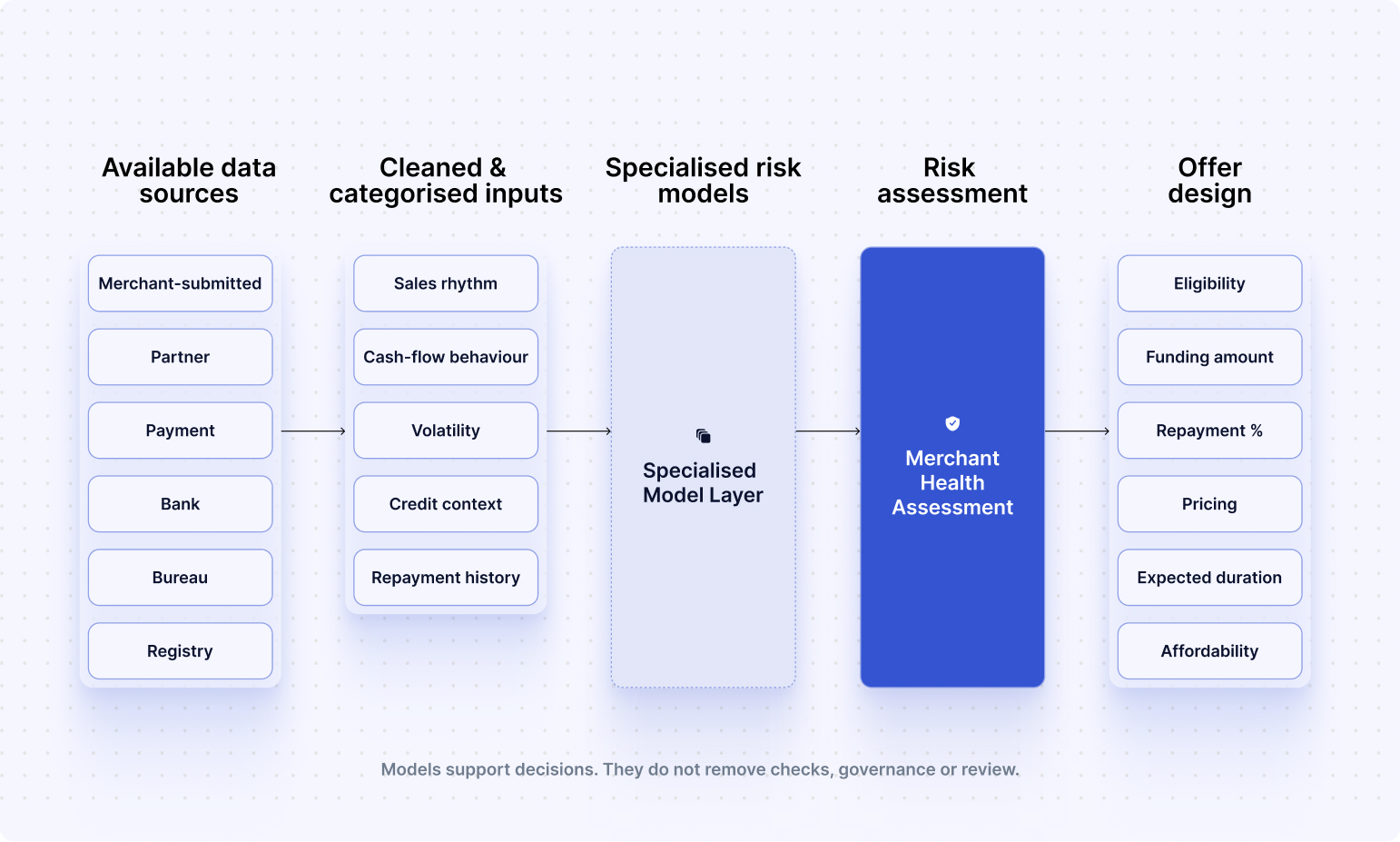
A credit score can help show part of the story but it cannot tell you the whole story of a merchant's business. That matters in merchant financing because past risk is only one part of the decision. The more useful question is whether the business can take funding now and repay from future trading.
And that depends on the business in front of you. Is revenue growing, flat or seasonal? Are card takings stable? Are refunds or chargebacks rising? Does the bank account tell the same story as the payment data? Is the merchant trading through one channel, or several?
No single score answers all of that.
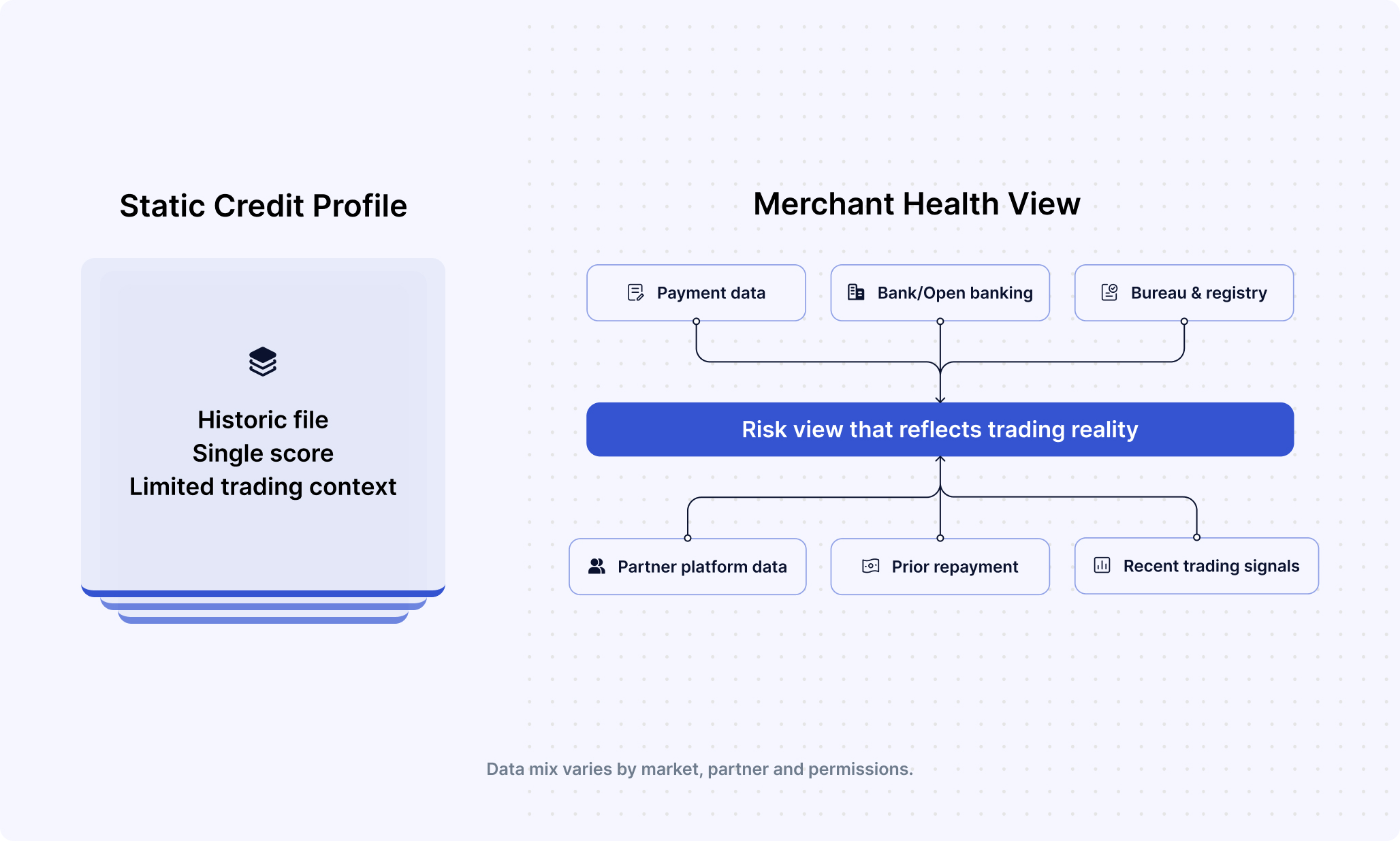
At YouLend, risk modelling starts with the fullest picture we can responsibly build from the data available. That may include:
- Merchant-submitted information
- Bureau and registry data
- Bank or open-banking data
- Payment data
- Partner platform data
- Prior repayment history.
The exact mix changes by geography, partner relationship, data availability, product route, local requirements and programme maturity. But the principle stays the same: use the signals that explain merchant health, test them against outcomes, and turn that view into offers that are better calibrated for the merchant, useful for the partner, and sustainable over time.
That is the story behind the model. The risk view starts with the data available, becomes stronger when the right signals are tested, and only matters commercially when it shapes the funding offer itself.
The work is choosing the signals that matter
Access to more data is only the starting point. The data has to be cleaned, categorised, tested and understood.
Payment data can show trading rhythm, but it may only cover one channel. Bank data can show cash flow, but it needs transaction categorisation. Bureau data can show credit history, but it may lag what is happening inside the business now. Partner data can be highly relevant, but only where it is available, permissioned and predictive.
The real work is deciding which signals change the risk view, for example:
- For a payments partner, current trading signals might include sales volume, volatility, refunds, chargebacks and settlement behaviour.
- For a marketplace, useful signals may sit closer to seller performance, trading consistency and customer feedback.
- For an accounting or business-management platform, the relevant picture may come from cash flow, invoices, payment timing or account activity.
The point is that embedded financing creates a different data problem from traditional lending. Traditional data still matters. The decision gets stronger when recent trading context is added to it.
This is why the first step in a partner programme is often a data exercise. Before anyone argues about launch route or merchant messaging, the partner and YouLend need to understand what data exists, what it represents, which cohorts it covers, and where it can support a responsible offer.
Current trading signals keep the view alive
SMEs change quickly.
A restaurant before a seasonal peak does not look the same as that restaurant after the peak. An online seller with a strong sales month does not look the same before and after that demand appears. A merchant with steady sales and rising refunds does not have the same risk profile as a merchant with the same revenue and cleaner settlement behaviour.
Static data can miss those differences.
Current trading signals help YouLend build a view that can move with the business. Where recent payment, bank, marketplace or platform data is available, the model can read what is happening closer to the funding moment.
That matters for revenue-based financing. Repayment is linked to trading performance, so the risk question is tied to future sales and cash flow. I have written separately about the forecasting systems we have built at YouLend, including the role of seasonality and probabilistic forecasting in SME underwriting. This article is the companion argument: better risk assessment depends on the data architecture behind the decisio and the distinction is important.
Recent data does not mean automatic approval. It does not remove KYC, credit checks, affordability checks, fraud controls or review. It helps the model see the business as it is trading now, rather than relying only on older or partial signals.
Different models read different parts of merchant health
Forcing every merchant into one generic score loses information.
A merchant's health has several parts:
- Revenue stability
- Cash-flow pressure
- Business and owner credit context
- Repayment history for returning merchants
- Partner activity where available
- Operating context
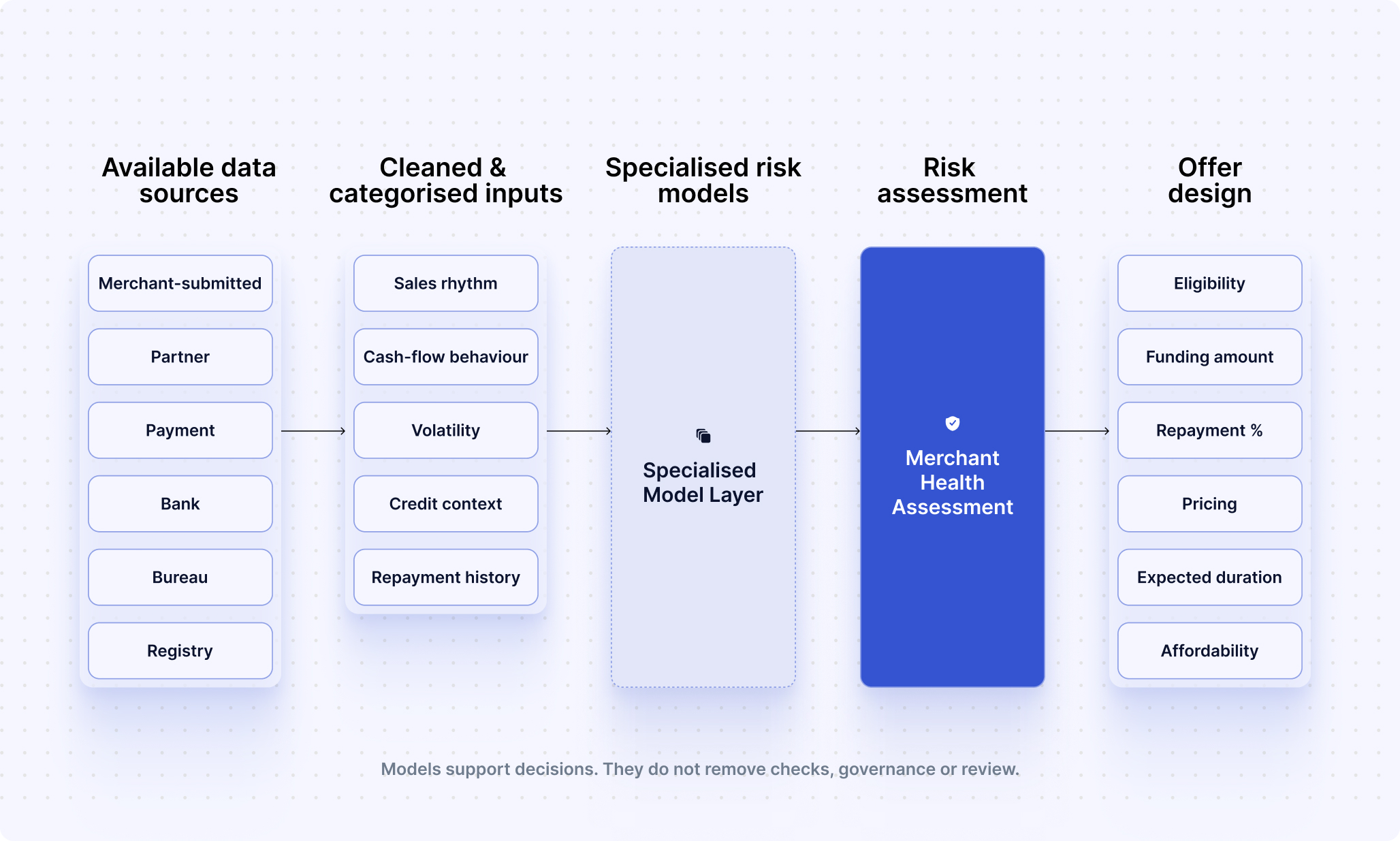
That is why YouLend uses a modular approach to risk modelling. Different model components can assess different aspects of the merchant picture before those outputs support the wider risk assessment and offer structure.
Some models are general enough to travel across markets, especially where they use common signals such as revenue, payment activity or bank-statement data. Others become more market-specific where YouLend has enough local data and repayment outcomes. For partners with rich, permissioned data, models can become more partner-specific as the programme matures.
That layering matters. A merchant in one market may have a very different data profile from a merchant in another. A merchant funded through one type of partner may also look different from a merchant funded through another. The model setup has to reflect that.
Our goal is not to make the process sound complicated. It is to avoid pretending that merchant risk is simpler than it is.
Risk modelling shapes the offer, not just the decision
Risk modelling has to do more than say yes or no. In merchant financing, the risk view helps shape the offer itself. That can include eligibility, risk band, funded amount, repayment percentage, factor rate and expected repayment duration, subject to checks and final review.
The offer has to work in several directions at once. It has to fit the merchant's trading capacity. It has to make commercial sense for the partner programme. It has to remain sustainable for YouLend and its capital partners. And it has to respect the controls around lending, servicing, reporting and collections.
That is why offer design is a risk problem as well as a product problem.
Two merchants might ask for the same amount of funding. The right answer may still be different. One may have stable revenue and clean repayment signals. Another may have similar headline revenue but more volatility, thinner history or signals that call for more cautious terms.
The model does not need every merchant to look the same. It needs enough predictive evidence to size and price the offer responsibly.
Model infrastructure is part of the product
Good risk models do not stay good by assumption. They need monitoring and validation across markets, partners, merchant cohorts and time periods. A signal that works well in one market may not travel cleanly to another. A partner data feed may be rich but partial. A model can drift as merchant behaviour changes.
That is why the modelling layer has to be supported by infrastructure that monitors, validates and improves performance across markets.
For partners, this matters because embedded financing is not a one-off campaign. A capital programme has to keep working after launch, across new cohorts, trading conditions, data quality and routes to market.
The partner should not have to become a lender to benefit from that infrastructure. The partner owns the merchant relationship. YouLend provides the financing infrastructure behind the programme: capital, underwriting, risk, compliance, servicing, reporting, collections and renewal logic.
The better the model infrastructure, the easier it becomes to keep the programme calibrated as it grows.










.jpg)


