.jpg)

Suppose a payments platform wants to offer financing through the dashboard where it already onboards merchants and sends them money. It would make sense for financing payouts to use the same systems. But if a financing provider requires payouts to run through its own infrastructure, the platform loses that choice.
With YouLend's modular capital platform, that business can use our capital and credit models while sending approved funds through its own systems. It can keep a part of the operation it already knows how to run, with YouLend providing the funding and making the credit decisions. Read the component breakdown in our previous blog here.
We'll follow that payments platform through its payout and servicing choices, then compare it with a business that brings its own capital and credit models. In each case, the diagrams show how responsibilities can be divided between the partner and YouLend.
Use your own payout systems with YouLend's capital.
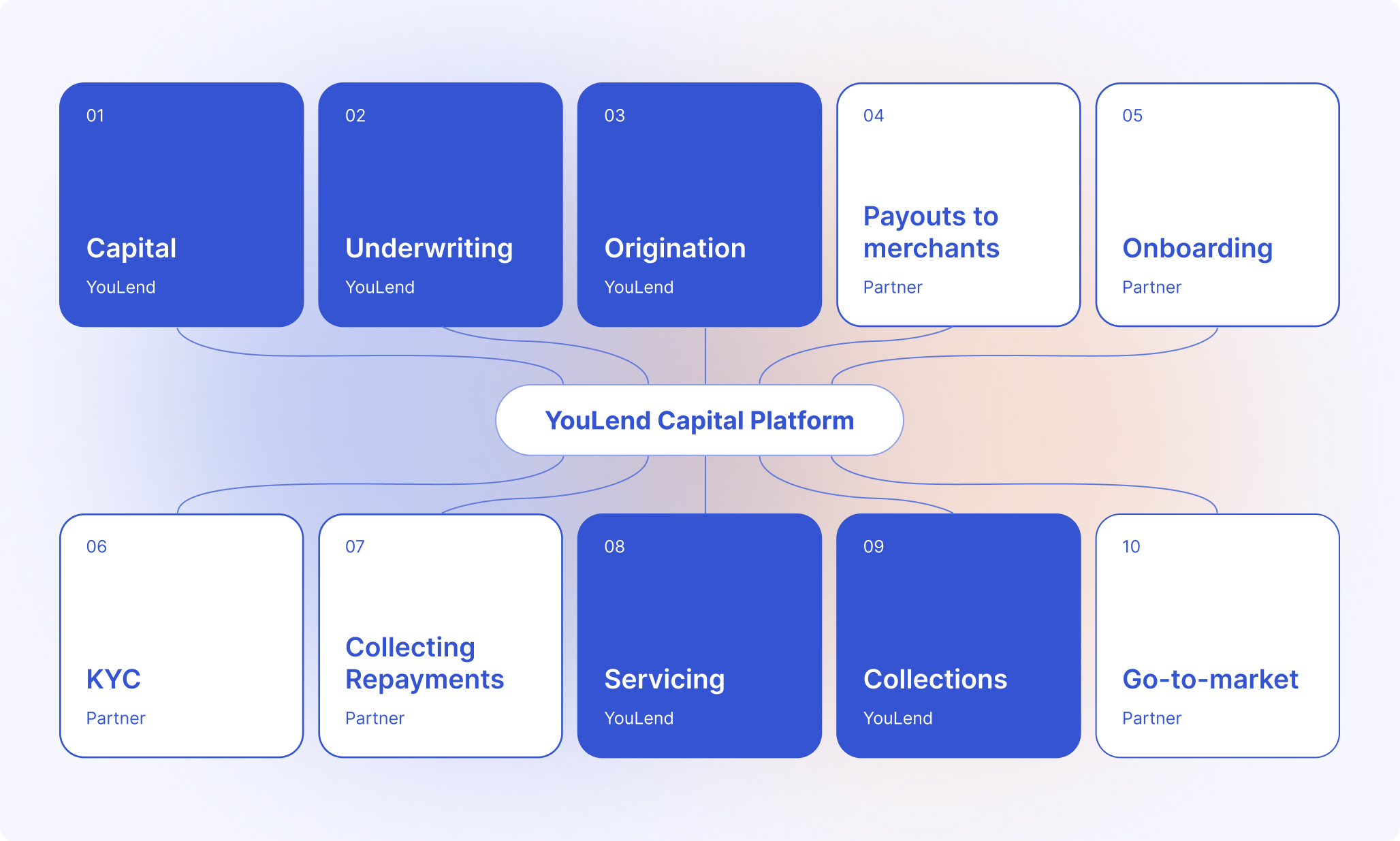
Under this arrangement, YouLend supplies the capital and makes the credit decisions. The platform receives an agreed funding instruction and sends the approved funds to the merchant through its own payout systems. Its payments team can manage those transfers alongside its existing work.
The diagram compares this with a setup where YouLend handles payouts. Only the payout responsibility changes. The platform keeps onboarding, repayment collection and merchant communications, while YouLend continues to handle the financing responsibilities shown. Existing KYC checks can be used where permitted under an agreed reliance arrangement.
The teams still need to connect their systems, confirm what was paid and agree how failed payments are resolved. Once that work is scoped, the platform can decide whether handling payouts is worth taking on.
The choice to send the funds is separate from the choice to supply them or make the credit decisions. It is also separate from deciding who supports merchants after they receive financing.
Decide how your team supports merchants after funding.
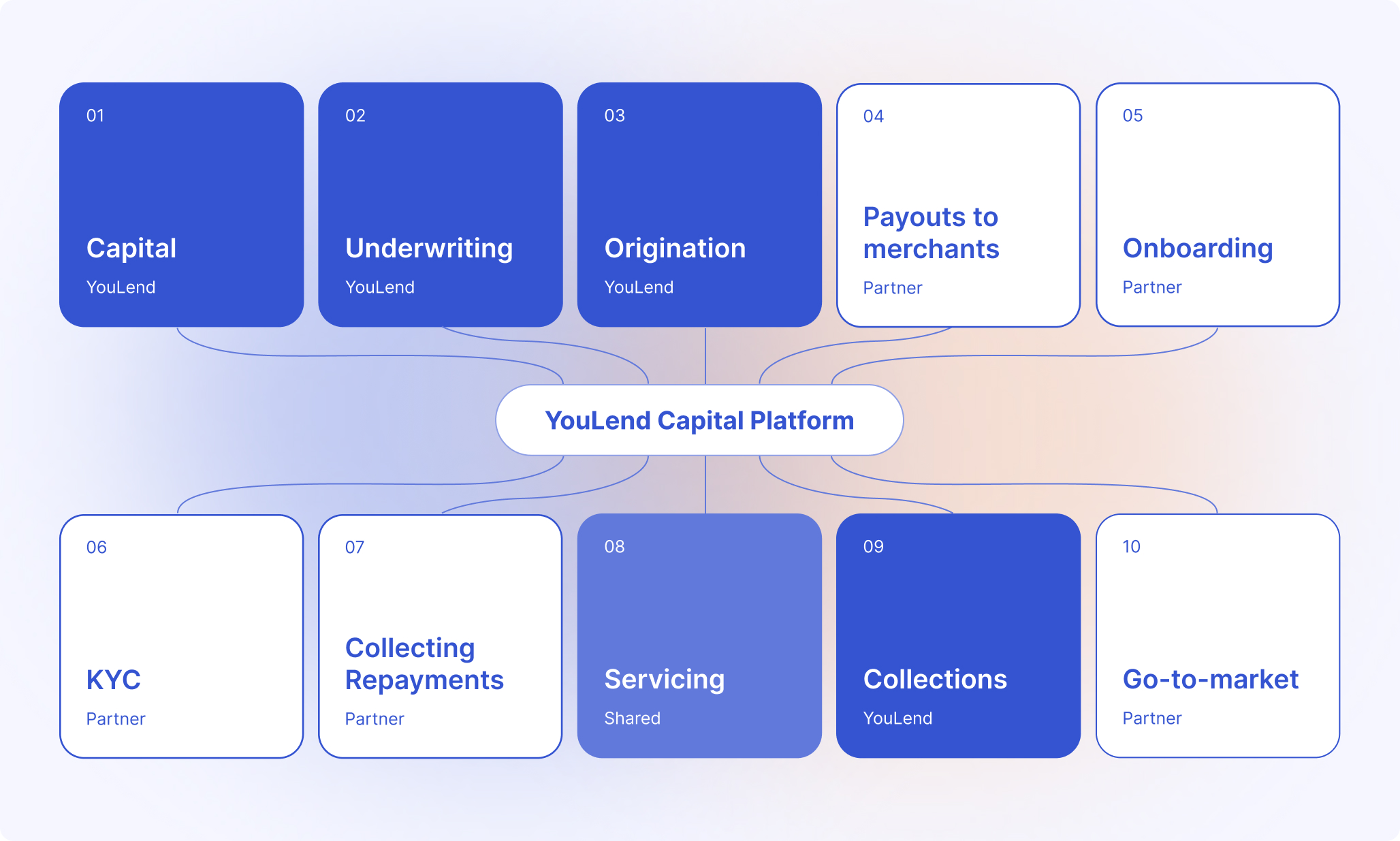
Suppose the platform takes on payouts. Later, its account managers begin receiving financing questions during their regular merchant conversations. The platform already sends the funds; it now wants its team involved in the ongoing support as well.
It can consider a shared servicing arrangement, with account managers answering agreed routine questions and bringing YouLend in when specialist input is needed.
In the comparison shown here, servicing changes from YouLend to a shared responsibility. The platform still handles payouts, YouLend still supplies the capital and makes credit decisions, and the remaining responsibilities stay as they were.
The teams would agree what account managers can answer, what information they can access and who follows up with the merchant when a query moves to YouLend. Any change would be assessed and agreed before it takes effect.
Already have capital and credit models? Keep using them.
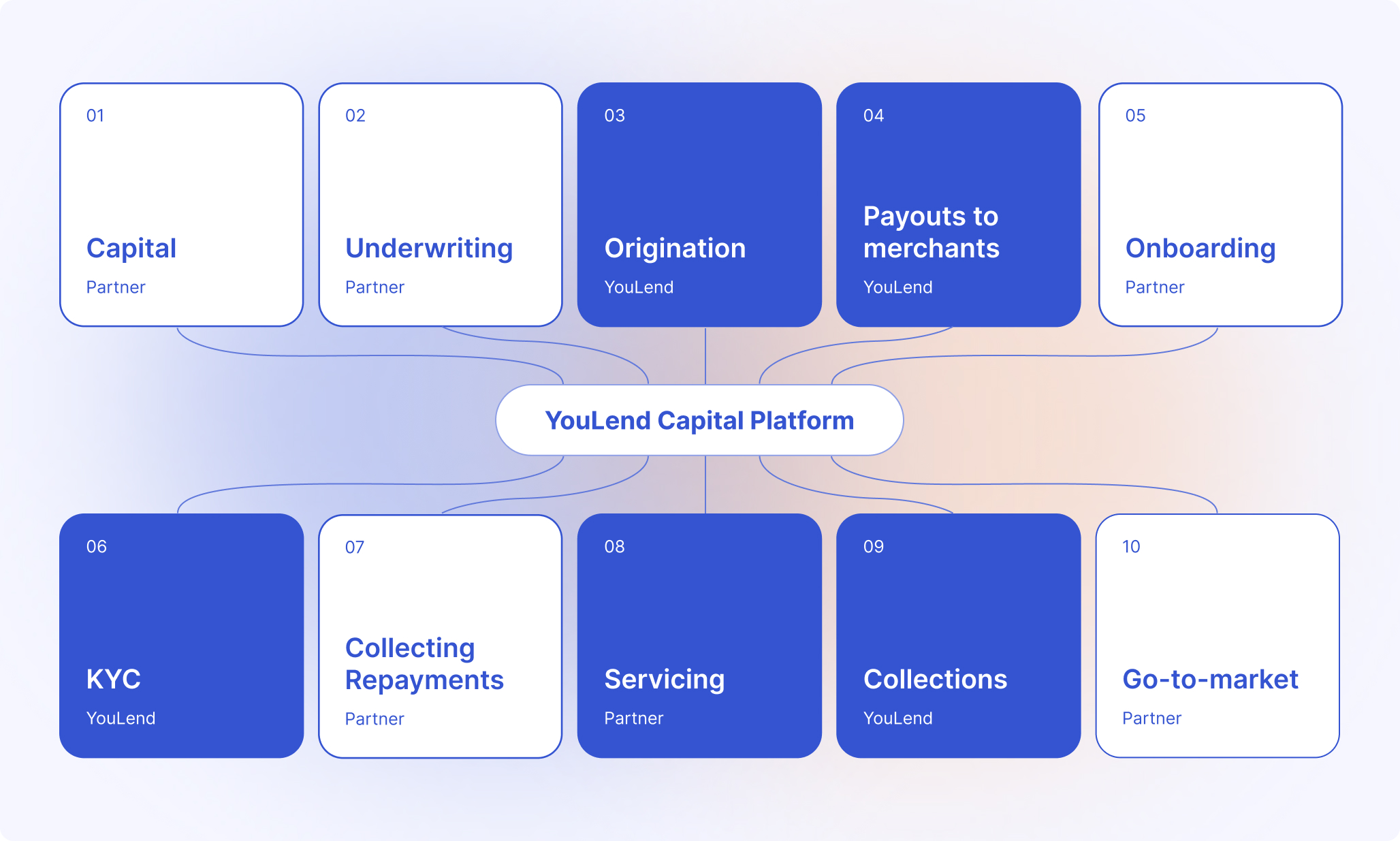
The same choices work in the other direction. Our payments platform uses YouLend's capital and credit models while handling payouts. Another business may already have the capital and credit expertise, but want YouLend to originate financing, complete KYC and send the funds to merchants.
In this configuration, that business keeps its funding and underwriting, alongside onboarding, repayment collection, servicing and marketing. YouLend handles origination, KYC and payouts, and leads collections.
This gives an established program a way to get support in specific areas while continuing to use its own capital and credit expertise. The teams define where that support begins and ends, including when the partner's servicing team passes a case to YouLend for collections.
Capital and underwriting are separate choices too. A business with funds to deploy can choose a partner-funded configuration in which YouLend handles the credit decisions. Bringing your own capital does not require you to run your own credit models.
What would you keep, and where would you want support?
Explore the other configurations below to see how your team and YouLend could divide the work. Choose the one closest to what you have in mind, then talk to us about how we could adapt it around the parts you want to keep and the support you need.








.jpg)